A high school Spanish curriculum should help students build real-world communication skills, cultural understanding, and measurable language proficiency. This blog explains how modern Spanish programs can combine speaking, listening, reading, writing, performance-based assessment, and digital learning tools to support proficiency-focused instruction and help students use Spanish confidently in real-life situations.
Spanish is one of the most widely taught languages in secondary schools around the world, and honestly, it's easy to see why. With over 500 million native speakers across more than 20 countries, Spanish is one of the world's most influential languages. And a well-designed high school Spanish curriculum can help students build valuable and practical opportunities from an early stage. It's a genuine gateway to real conversations, real relationships, and real opportunities.
But here's the thing: the way we teach it has changed significantly. And for the better. Today's Spanish programs have moved well beyond vocabulary lists and verb conjugation drills. The most effective ones are built around something far more meaningful, helping students actually use the language, not just study it. That shift matters more than many people realize.
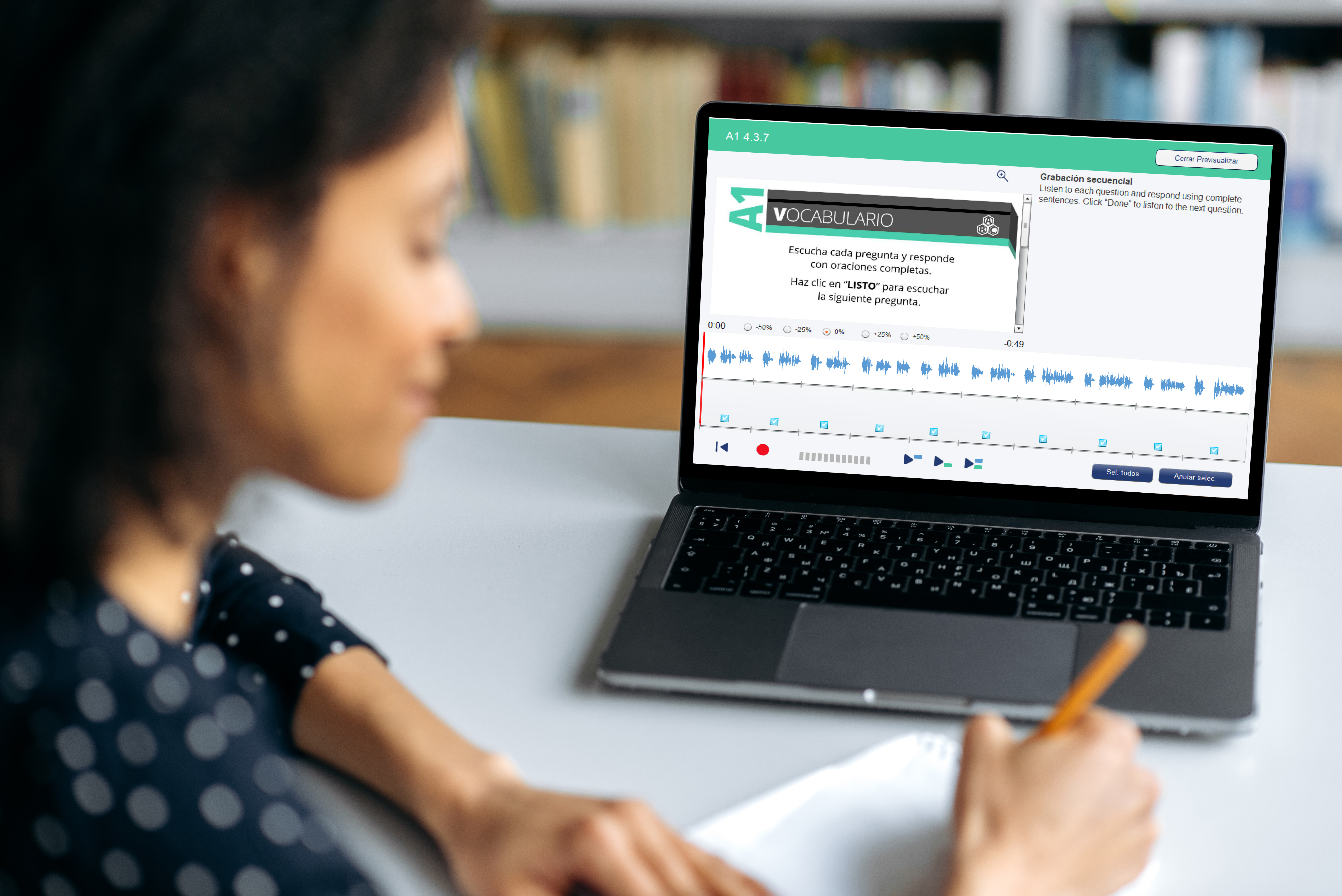
While many schools are reinforcing a communicative approach with digital curriculum platforms, Robotel's SmartClass Spanish Curriculum isn’t limited to structured speaking, listening, reading, and writing activities. We have smartly combined ready-to-use lessons with interactive practice, making it easier for teachers to implement proficiency-focused instruction.
It Starts with a Different Kind of Goal
Ask yourself: What does success look like at the end of a high school Spanish program?
For a long time, the answer was tied to content coverage. Did students finish the textbook? Did they pass the grammar test? But those questions were never really about language. They were about completion.
Modern curriculum design asks a better question: What can this student actually do with Spanish right now?
That reframing, from content to competence, is at the heart of proficiency-based language education. And it changes everything, from how lessons are planned to how students are assessed.
Many US schools now align their Spanish programs with the ACTFL World-Readiness Standards, which organize language learning around five areas: Communication, Cultures, Connections, Comparisons, and Communities. These aren't abstract categories. They reflect what it genuinely means to be a capable language user in the real world.
The Three Things Every Spanish Programme Needs
When you strip it back, a strong high school Spanish curriculum is built on three interconnected pillars.
Communication skills: Helping students interact, interpret, and express ideas in Spanish across different types of situations.
Cultural competence: Developing the awareness to understand why people communicate differently, not just how.
Proficiency development: Tracking real growth in what students can do, not just what they've been taught.
These aren't separate subjects. They work together, and the best programs weave them through every unit, every lesson, and every assessment.
Robotel's SmartClass supports all three pillars simultaneously by combining authentic language practice, cultural content, and built-in progress tracking within a single learning environment.
Communication: More Than Just Talking
Let's be honest, grammar has its place. But it was never meant to be the destination. Grammar is a tool. It helps students communicate more clearly and more precisely. When it becomes the sole focus, something gets lost.
ACTFL describes communication in three modes, and all three matter in a well-designed Spanish classroom.
Interpersonal communication is the spontaneous, back-and-forth kind, the conversations students would have ordering food in Madrid, asking for directions in Mexico City, or chatting with a colleague in Buenos Aires. In class, this shows up as role-plays, paired interviews, debates, and collaborative tasks where meaning is negotiated in real time. Students learn to listen, respond, and recover when they don't catch every word.
Interpretive communication is about understanding authentic content, news articles, podcasts, social media posts, short films, and literature. This is where students encounter Spanish as it's actually spoken and written, not as it appears in a textbook. Interpretive tasks build comprehension while also broadening students' perspectives on the incredibly diverse Spanish-speaking world.
Presentational communication is where students create something for an audience, a persuasive essay, a multimedia project, an oral presentation, a digital story. These tasks develop the ability to organize ideas and communicate them clearly and confidently.
A Spanish program that addresses all three modes gives students a far richer, more rounded experience of the language.
Culture: Not Just Holidays and Food
One of the most important shifts in modern language education is how culture is handled.
For years, cultural content often meant a unit on Día de los Muertos here and a discussion of paella there. Interesting? Sure. But it barely scratched the surface of what cultural competence really involves.
Today's best programs weave culture throughout the entire curriculum rather than parking it in a standalone unit. And they go deeper, exploring why people in different Spanish-speaking regions behave and communicate the way they do, not just observing that they're different.
Students might examine how family dynamics vary across Latin America. They might look at educational structures in Spain versus Chile. They might explore how professional communication norms differ between countries or how environmental activism is showing up in communities across the Spanish-speaking world.
These conversations do something textbooks rarely can. They build empathy. They develop the intercultural awareness that helps students navigate real relationships across cultural differences, and that's a skill that goes far beyond language class.
Proficiency: Measuring What Students Can Actually Do
One of the most practical improvements in high school language education has been the widespread adoption of proficiency benchmarks.
Rather than tracking whether students completed Chapter 7, proficiency-based frameworks describe what students are able to do at each stage of their development. ACTFL's guidelines are among the most commonly used, and they offer a clear picture of growth from novice through advanced levels.
Most high school Spanish programs aim for students to reach somewhere between Novice High and Intermediate Low by the time they graduate. At those levels, students can hold simple conversations, handle familiar everyday situations, ask and answer questions, and string together basic connected sentences on personal and community-related topics.
That might sound modest, but for a student who started with zero Spanish, it's genuinely meaningful. And it represents real communicative ability, not just memorized phrases.
The key is that curriculum design, instruction, and assessment all need to align with these targets. If students are being tested on things they'll never be asked to do in the real world, the data isn't telling you much.
SmartClass further supports the very process by organizing activities based on individual learners' needs and abilities. This enables teachers to match the proficiency objectives and assign targeted practice to each student.
Technology: Expanding What's Possible
Technology has become an essential part of delivering on everything described above, especially for teachers managing large, mixed-ability classes.
Digital language labs and interactive platforms give students more opportunities to practice speaking and listening than any single classroom period can provide. They allow learners to work at their own pace, revisit content they find challenging, and engage with authentic Spanish materials from across the Spanish-speaking world.
For teachers, technology opens up a different kind of visibility. Rather than waiting for the end-of-unit test to find out who's struggling, digital tools can surface real-time data on student progress, helping teachers identify gaps early and adjust their instruction accordingly.
When it's implemented thoughtfully (rather than just added for the sake of it), technology doesn't replace the richness of a good language classroom. It extends it.
Assessments That Actually Reflect Language Learning
It would be a shame to build a communicative, culturally rich, proficiency-based Spanish program, and then assess it with a multiple-choice grammar quiz.
Assessment needs to reflect the goals of the curriculum. That means making room for performance-based tasks that show what students can actually do: simulated conversations, oral presentations, listening and reading tasks with authentic materials, project-based work, and digital portfolios that document growth over time.
Formative assessment is just as important here as summative. When teachers are checking in regularly on how students are progressing, not just at the end of a unit, they can offer support at the moments when it's most useful.
Beyond the Classroom
The real measure of a high school Spanish program isn't the final exam grade. It's whether students leave with something they can actually use.
A student who graduates with genuine communicative ability in Spanish, who can hold a conversation, navigate unfamiliar cultural situations, and continue learning the language independently, is far better prepared for higher education, international workplaces, and a world that's more interconnected than ever before.
That's the goal worth designing toward. And the good news is that the frameworks, tools, and approaches to get there are more accessible than they've ever been.
If you're building or refining a high school Spanish curriculum, the foundation is clear: prioritize authentic communication, embed culture throughout, measure real proficiency, and use technology to support it all. Everything else follows from there.
So, why not switch to digital curriculum solutions with us? At Robotel's SmartClass Spanish Curriculum, we help educators put all these fundamentals into practice. Our authentic communication tasks, interactive activities, independent learning, meaningful progress tracking, auto-graded activities, and flexible lesson delivery strengthen and support both classroom and hybrid learning.
Connect with us to discover unique ways to enhance your high school Spanish curriculum.
FAQs
1. What should a high school Spanish curriculum include?
A strong high school Spanish curriculum should develop communication skills, cultural understanding, and measurable language proficiency. It should include speaking and listening practice, authentic reading materials, writing activities, cultural exploration, and performance-based assessments that demonstrate what students can do with Spanish.
2. How should student progress be assessed in a high school Spanish program?
Student progress should be measured through both formative and summative assessments. Simulated conversations, oral presentations, listening activities, writing assignments, project-based work, and digital portfolios can provide a clearer picture of students’ communication skills than grammar tests alone.
3. What is Robotel’s SmartClass Spanish Curriculum?
Robotel’s SmartClass Spanish Curriculum is a supplemental digital curriculum designed for beginner-to-intermediate learners at CEFR A1–A2 levels. It includes more than 850 ready-to-use activities, with a strong focus on Spanish-speaking and listening skills. The activities are integrated into the SmartClass Teaching Platform and can be assigned during class or as homework.
4. Can Robotel’s Spanish Curriculum supplement an existing high school program?
Yes. Teachers can use Robotel’s Spanish Curriculum alongside an existing textbook or school curriculum. They can assign the complete sequence of activities or select individual exercises based on a particular topic, skill, or student proficiency level. This makes it suitable for schools that want to add more interactive speaking, listening, and pronunciation practice without replacing their current program.
5. How does SmartClass help students improve their Spanish speaking and listening skills?
SmartClass gives students opportunities to record and review their responses, practise pronunciation, participate in paired or group activities, and complete interactive listening and speaking exercises. Teachers can monitor performance, provide targeted feedback, assign differentiated activities, and use built-in assessments and reports to track student progress.



.svg)


Leave a comment