If walking into a new school is hard, imagine walking into one where you don’t speak the language and where your teacher expects you to keep up with twenty other students at completely different proficiency levels—that is something else entirely.
This is the daily reality of ESL teachers working with newcomers at the secondary level. A structured newcomer support curriculum is not only a nice-to-have for these classrooms, but it’s also a foundation for everything else. In this guide, we will break down what that looks like in the real world, what it needs to include, and how the accurate digital tool can make it genuinely workable.
What Makes Newcomer ESL Different from Standard Language Teaching
If you think secondary newcomers are the same as students learning a foreign language by choice, then you’re wrong. They’re often navigating grief, displacement, interrupted schooling, and academic pressure, all at once, in a language they’re still acquiring. A newcomer support curriculum for ESL learners has to consider this reality and not just the language learning benchmarks.
It means that the curriculum needs to be more than just covering vocabulary and grammar. It has to build confidence in speaking, offer enough repetition for real retention, and give students a sense of progress, even when that progress is incremental.
It needs to meet teachers where they are presently. Most secondary ESL teachers are managing mixed-proficiency classrooms where one student is at the near-beginner level, and the other is approaching academic proficiency. Thus, a curriculum that balances both students is suitable for the real world.
The Core Elements of an Effective Newcomer Support Curriculum
Before jumping into the tools, let’s clarify what a strong curriculum actually requires.
Proficiency-level alignment:
A newcomer support curriculum for secondary students requires structure around recognized proficiency standards. WIDE and CEFR frameworks are the benchmarks most schools use, and a curriculum aligned to these gives teachers a consistent way to place students, track their progress, and communicate growth to administrators and families.
All four language domains:
Reading and writing get more classroom airtime because they are easier to assess on paper. However, newcomers, especially at the secondary level, would need intensive listening and speaking practice. It would need a curriculum that treats all four domains equally and builds them together to produce faster and more durable acquisition.
Flexibility without Chaos:
Teachers need to adapt to changes. A secondary ESL newcomer support curriculum that’s rigid and can’t survive in the real world. Simultaneously, flexibility without structure will lead to fragmented teaching. The best curriculum is the one that gives teachers a clear framework while allowing meaningful customization at the activity and lesson levels.
Immediate feedback:
Newcomers will benefit from knowing in real time whether they’ve understood something correctly or not. Waiting for days for graded feedback will break the learning loop. Auto-graded activities and instant pronunciation feedback are not just convenient; they’re pedagogically significant for students.
Building a Workable Lesson Structure
Let’s have a look at the workable practical framework that will work within a newcomer support curriculum for high school running for 45-60 minutes.
- Activation (5-8 minutes): A listening clip, picture prompt, or short vocabulary can help bring prior knowledge before any new input.
- New language input (10-15 minutes): Introduce new language through context, like an authentic video, a dialogue, or a real-world scenario, before any explicit grammar instruction.
- Guided practice (15-20 minutes): Structured digital activities where students use the new language with scaffolding and immediate feedback in place.
- Speaking production (10-15 minutes): Independent speaking practice, including AI conversation activities, role plays, or short recorded responses, can help students produce language without any script.
- Reflection (5 minutes): A quick and brief self-assessment or exit check to help students track their own progress.
This structure will work as it mirrors the natural sequence of language acquisition: comprehensible input first, supported practice second, and independent use third.
How SmartClass Supports a Newcomer Support Curriculum
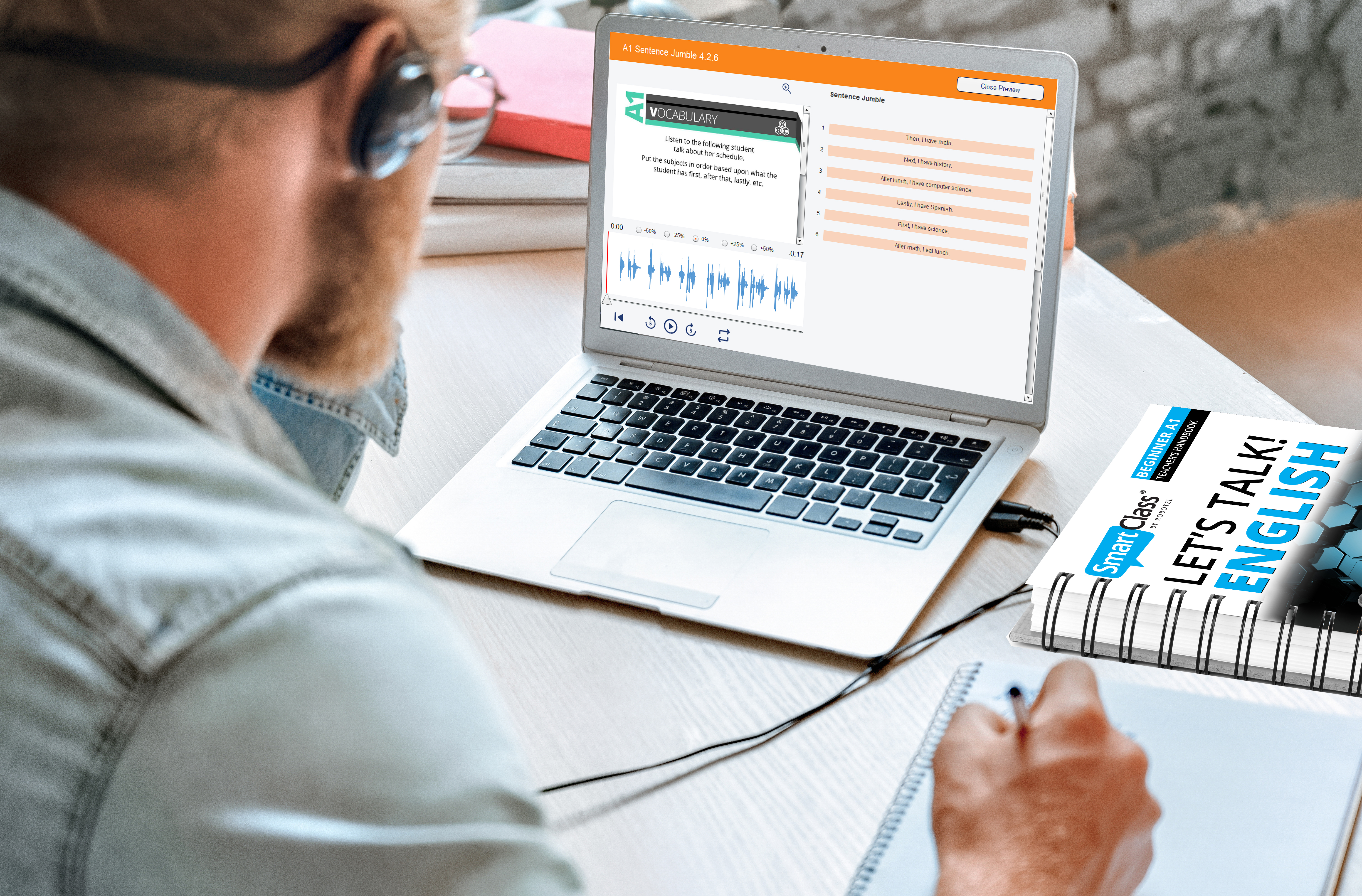
SmartClass allows an interactive, engaging, and student-centered approach to English language acquisition. The digital Newcomer English curriculum adapts to any teaching style seamlessly and can be used for in-person, hybrid, or fully online classes.
For those building a newcomer support curriculum, it actually holds up under real classroom conditions. With this, you’re not locked into a single delivery mode, and the platform doesn’t require your school to be fully resourced to use it effectively.
The curriculum includes 3,000+ engaging activities, ranging from beginner to advanced, with five complete proficiency levels aligned with WIDA standards, making sure of a smooth progression from foundational receptive and productive skills to advanced receptive and productive skills.
This is a substantial content bank. For a newcomer support curriculum, having mixed-ability classrooms, the ability to pull activities by proficiency level, instead of year group, is the exact flexibility that makes daily planning manageable.
Teachers can customise existing activities or create their own, digitizing and organising original instructional content across all four language domains to address specific learning needs.
AI-based speech recognition enables students to practice their pronunciation skills and receive immediate feedback without any teacher intervention. To newcomers, who hesitate to speak in front of peers, it gives a low-stakes environment to practice before they’re ready to participate publicly.
Mostly 50% of the activities are auto-graded, providing instant feedback to students and saving time for teachers. For secondary ESL teachers managing large rosters of newcomers at varying levels, it is not a small operational advantage.
The SmartClass Placement Test examines student proficiency and places students into their respective SmartClass level, making sure of effective and personalised learning from the start. In reality, it means teachers aren’t guessing at the starting point, which is the most time-consuming challenge in newcomer classrooms.
Conclusion:
Secondary newcomers deserve a curriculum that considers their situation seriously, one that’s structured enough to meet individual needs, to support them enough that teachers can actually implement it without burning out.
If you’re looking for something like this to strengthen your secondary ESL newcomer support curriculum, explore what SmartClass has to offer or request a free demo to witness the platform in action.




.svg)


.png?width=352&name=Mask%20group%20(1).png)
Leave a comment