Effective Spanish lesson plans for secondary students should combine clear language objectives, listening input, structured speaking practice, formative feedback, and opportunities for independent language use. This blog explains a practical 45–60 minute lesson framework and shows how SmartClass by Robotel can support Spanish teachers with CEFR-aligned digital activities, AI-powered speaking and pronunciation practice, auto-graded exercises, progress tracking, and flexible tools for mixed-ability classrooms. It also explores how digital resources can reduce lesson-planning workload while helping students build stronger listening, speaking, vocabulary, and communication skills.
Teaching Spanish to secondary-level students may sound straightforward, but it’s not. There are students at wildly different starting points, limited class time, a curriculum to cover, and the ever-present pressure to make speaking practice actually happen; it’s not just a theory but a noisy classroom where half of the students would disappear into their hoodies.
The difference between good Spanish lesson plans is the one that moves and the one that stalls. We will break down what effective planning looks like for secondary Spanish classrooms and how the right digital tools can make it sustainable.
Why Lesson Planning Matters More in Language Classes
Language learning is cumulative. Every lesson either builds on the last or leaves a gap that compounds over time. In secondary classrooms, where students may be entering with a full year of prior Spanish knowledge or none at all, the planning is a real challenge.
Effective Spanish lesson plans require a few things to be done simultaneously: introduce new vocabulary and grammar, provide meaningful listening and speaking practices, offer chances to revisit previous lessons, and give students feedback on how they’re doing. When trying to build all of these from scratch, week after week, it is exhausting and tiresome. That’s why having a solid structure and the right supplement tools matters.
Four Pillars of Strong Secondary Spanish Lessons
Before we start to talk about planning templates and tools, let’s look into what the Spanish lesson should include.
- A Clear Language Objective:
Not a topic, but an objective. ‘Students should be able to describe daily routines using reflexive verbs’ is an objective. ‘Daily routines’ is just a topic. This distinction matters, as a clear objective tells what success looks like and how to assess it.
- Listening Input:
Secondary students must also hear the language apart from just reading it. Authentic audio and video content, such as native speakers, real-world conversations, and situational dialogues, provides students with a natural rhythm, pace, and pronunciation that no textbook transcript can replicate.
- Speaking Practice:
Most lessons lack this, not because teachers undervalue it but because it’s quite hard to orchestrate. Pair work can descend into English quickly. Whole-class speaking is dominated by a few confident students. Structured speaking activities with a built-in prompt and response format work far better, and digital tools make this significantly more manageable.
- Formative Feedback:
Students deserve to know how they’re doing in near-real-world contexts, not two weeks later when the grades come back. Auto-graded activities, immediate feedback on pronunciation, and progress tracking are what turn practice into learning.
Building a Lesson Plan: A Practical Framework
Here’s a simple planning structure that works well for Spanish lesson plans for secondary classrooms running 45-60 minutes:
- Warm-up (5-8 minutes): A quick vocabulary review, listening to a clip, or a low-stakes speaking prompt to activate prior knowledge.
- New input (10-15 minutes): Introduce the new concept through context, a video, dialogue, or reading, rather than explaining grammar first.
- Guided practice (15-20 minutes): Structured activities where students use the new language with support. This is where digital platforms come in handy.
- Production (10-15 minutes): Students use the language more independently: a role play, a short presentation, or an AI conversation activity.
- Wrap-up and feedback (5 minutes): A quick check for understanding self-assessment, or exit reflection.
The structure mirrors how language acquisition actually happens: you hear it, understand it in context, practice it with support, and then use it on your own.
How SmartClass Supports Spanish Learning Plans
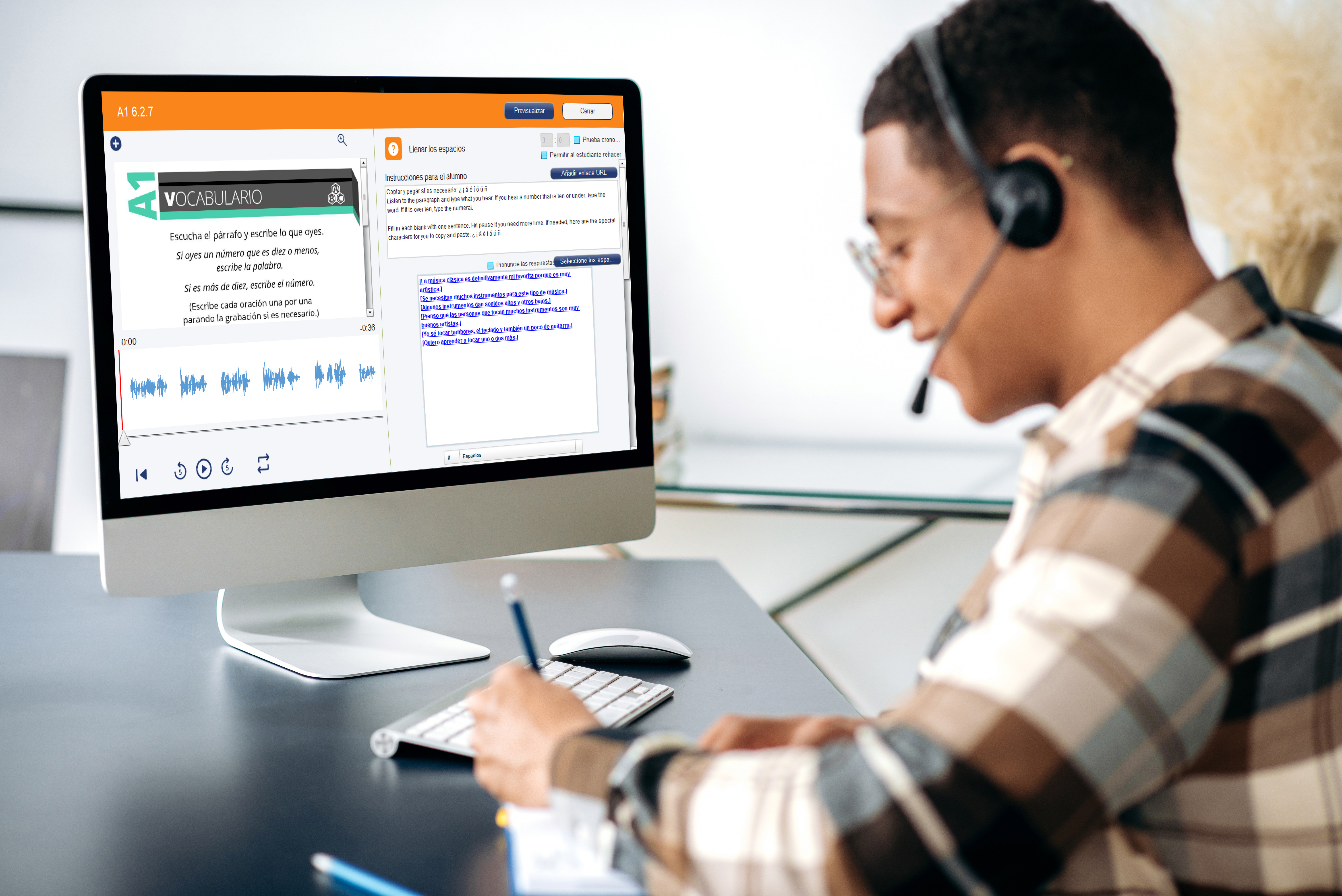
SmartClass offers an interactive student-centric approach to teaching Spanish, focused on listening and speaking. It is designed to assist any kind of teaching style and can be used for in-person, hybrid, or fully online classes.
This flexibility is significant for secondary teachers. The platform adapts to either running a blended classroom or a fully digital program instead of forcing the teachers to adapt to the platform.
The SmartClass Spanish curriculum spans beginner to intermediate levels, CEFR A1 to A2, and includes over 850 digital activities, including projects, assessments, and conversation tasks. That’s a substantial bank of ready-to-use content that you can slot directly into your Spanish lesson plans instead of building one from scratch.
Teachers have the flexibility to download the full curriculum or filter and select specific activities to supplement their daily lessons. They can also assign, edit, and create their own activities within the platform to meet students’ specific needs. In practice, it means you’re not locked into a rigid sequence; you can pull activities by skill, topic, or proficiency level depending on where your class is at.
Speaking practice is the persistent pain point in secondary Spanish classrooms. SmartClass addresses it through AI-powered conversations and pronunciation practice, giving students more speaking opportunities and immediate feedback.
The Smart Activity Builder is separate. It lets you instantly create five auto-graded activities from any vocabulary list, useful when you need to build something bespoke to your syllabus or textbook without spending any evening doing it. For Spanish lesson plans for teachers who are already stretched thin, that’s a meaningful time-saver.
Around 50% of activities are auto-graded, saving teachers time and providing students with instant feedback, allowing them to take ownership of their learning and practice at their own pace. For secondary teachers managing large class sizes, that’s not a small thing.
Differentiating for Mixed-Ability Classes
One of the trickiest aspects of secondary Spanish lesson plans is the range of ability in any given room. Students who studied Spanish in primary school sit alongside those who’ve never encountered it. SmartClass enables students to redo activities, which supports learners who need more time while keeping confident students moving forward.
Teachers can also monitor students’ progress and provide targeted feedback, making it easier to identify who needs intervention early, rather than discovering it during an end-of-term assessment.
A Note on Pacing and Planning Ahead
Solid Spanish lesson plans don’t happen in isolation but in well-sequenced units in a well-planned term. Having a curriculum framework, whether it’s CEFR-aligned or tied to your local standards, gives a structure to work within, and tools like SmartClass give you the content to fill it meaningfully.
If you’re looking to build your secondary Spanish program with a digital curriculum that’s genuinely flexible, speaking-focused, and easy to integrate into your existing planning, explore what Robotel's SmartClass has to offer or request a free demo to see it in action.
Frequently Asked Questions
1. What should a good secondary Spanish lesson plan include?
A strong secondary Spanish lesson plan should include a clear language objective, listening input, guided practice, structured speaking activities, independent language production, and formative feedback.
2. How long should a secondary Spanish lesson be structured for?
For a 45–60 minute lesson, teachers can divide the class into a short warm-up, new language input, guided practice, independent production, and a final feedback or assessment activity.
3. How can teachers encourage more speaking practice in Spanish classes?
Teachers can use structured speaking prompts, role plays, pronunciation activities, pair work, presentations, and AI-powered conversation exercises to give every student more opportunities to speak Spanish.
4. How does SmartClass support Spanish lesson planning?
SmartClass provides ready-to-use Spanish activities, assessments, conversation exercises, AI-powered pronunciation and speaking practice, activity creation tools, auto-grading, and progress tracking that teachers can integrate into existing lesson plans.
5. How can Spanish teachers support mixed-ability students?
Teachers can differentiate lessons by assigning activities based on proficiency level, allowing students to repeat exercises, monitoring individual progress, and providing targeted support to learners who need additional practice.




.svg)


Leave a comment