
Cloud-Based vs. On-Premises Language Labs: A Guide

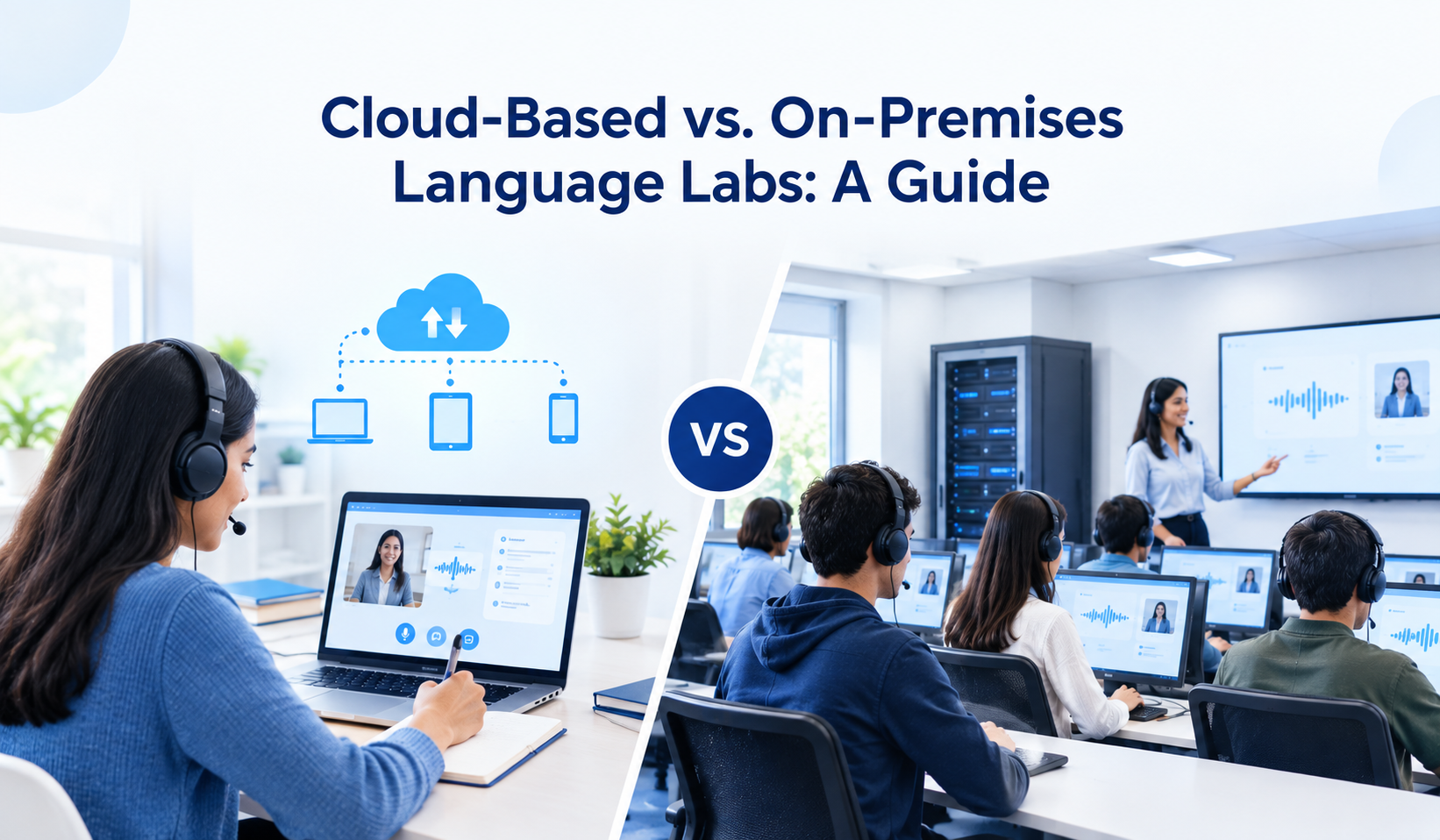
Choosing the best language lab is more complex today. You don’t have to only pick from cloud-based and on-premises solutions, but consider all factors associated with each one. This guide helps you understand the difference between both approaches in terms of teaching, scalability, security, maintenance, and more.
In the past few years, there has been a major change in the way languages are learned. The traditional language labs, which used to be mainly linked with special computer rooms and software installed locally, have now developed into more flexible digital learning environments.
This development has also raised a significant question for schools, colleges, universities and language institutes: should a language lab be based in the cloud or should it be hosted on the institution's own infrastructure?
Both approaches have their place.
A cloud-based language lab offers more flexibility and accessibility, enabling both teachers and students to carry out their learning through the internet, while a solution that is hosted on-premises or at the school gives an institution greater control over its local infrastructure and the way in which the system is managed.
The decision you make will be based on a number of factors, such as the network facilities of the institution, teaching approach, security needs, IT resources, and plans for future growth.
The differences between cloud-based and on-premises solutions
Although both models can be used for teaching language, their fundamental methods differ. Let’s take a look at the comparison.
Accessibility and Flexibility :
Cloud-based platforms are well suited to learning situations in which users need to connect from various locations. Teachers can assign activities for students to do in the classroom, at home, or in another type of learning environment according to the platform used.
This is especially beneficial for organizations providing hybrid or online instruction.
On-premise solutions are usually more closely linked with the institution's local infrastructure and can offer a good experience in a dedicated language lab or within the campus network, but remote access may require extra technical arrangements.
In cases where language learning takes place mainly on campus, this could be of little importance.
IT infrastructure and maintenance :
All language labs need a certain amount of technical support, but the kinds of responsibilities can vary a great deal depending on the deployment model.
The institution need not have the same amount of local server infrastructure if it uses a cloud-based solution. In these cases, the service provider may take over the hosting, the infrastructure, and some of the maintenance duties.
With an on-premises solution, the responsibility falls on the institution's IT team. The team has to manage several bottlenecks internally, like servers, local networks, backups, software installations, and system maintenance.
For organizations that already have a solid IT infrastructure and a technical staff, this can be a benefit.
Security and Data Management :
When using an on-premises system, the institution retains direct control over the physical infrastructure where its data is stored, and this can give a greater sense of control as well as keep up with the institution's existing policies.
Cloud hosting follows a different method. The data is kept on remote infrastructure which is managed in accordance with the provider's hosting and security practices.
When assessing security, it is necessary to go beyond the terms ‘cloud’ and ‘on-premises’. Institutions must find out where the data is stored, who is in charge of the infrastructure, what access controls are available, how the backups are managed, and what security measures the provider adheres to.
However, both methods have security benefits: hosting on school premises offers greater control over data security, while cloud hosting can lessen the requirement for external access to the school's network.
Scalability and future growth :
Language programs are never static! An institution can start with a single language lab and then grow to include more classrooms, campuses, teachers, or student groups. It might also add new languages or take on hybrid learning models.
Since cloud-based systems can make this kind of expansion more flexible, access does not have to be linked to just one physical server or classroom.
On-premises systems can likewise be scaled, but this may require extra infrastructure, hardware, networking, or IT planning. For organizations whose needs are predictable and are mainly concerned with the campus, an on-premises deployment could still be entirely appropriate.
Teaching and Learning Experience :
While the hosting model is important, it shouldn't take away from the real teaching experience.
A language lab should, in the end, assist students with their listening and speaking, give them opportunities to practice, allow them to receive feedback, and help them improve.
Teachers should therefore think about whether the platform offers features such as speaking practice, pronunciation, listening comprehension, assignments, assessments, student recordings, progress tracking, and interactive classroom activities.
For instance, SmartClass integrates an online teaching platform with an in-school Language Lab. The cloud-based Teaching Platform allows access through a web browser, whereas the special Language Lab offers the facilities needed for immersive classroom activities such as speaking, listening, assessment, pairing, and grouping.
This highlights that cloud and on-premises solutions must not be seen as opposing teaching approaches; instead, they can offer different methods of providing and hosting language-learning technology.
Why Choose SmartClass for Your Language Lab?
While evaluating the benefits of on-premises and cloud-based language labs, many largely focus only on where the technology is hosted. But it is imperative to consider whether or not the solution enables teachers and students to work efficiently with that technology.
This is where SmartClass by Robotel offers a different approach.
SmartClass combines an online Teaching Platform with an In-School Interactive Language Lab, allowing organizations to offer support for various teaching settings while ensuring that all aspects of language learning - the activities carried out, assessment, and progress tracking take place within the same system. The Teaching Platform is accessible via the web, and the Language Lab offers a special environment for real-time speaking, listening, pronunciation, and assessment activities.
Below are a few highlights of the SmartClass platform:
More Opportunities to Speak and Practice
SmartClass offers students more opportunities to practice speaking and listening by means of pairing, grouping, live monitoring, recording, and simultaneous testing. Its speaking activities also include AI for pronunciation and conversation practice.
Cloud-Based Flexibility with an In-School Language Lab
SmartClass features a web-accessible Teaching Platform and an interactive language lab located in the school. This enables teachers to create and assign activities, monitor students' progress, and give feedback while providing support for immersive and interactive language practice in the classroom.
Ready-to-Use Content with the Freedom to Customize
SmartClass provides curricula that are ready to use for English, German, Spanish, and Arabic, combined with interactive lessons and various language activities. The Smart Activity Builder enables teachers to create activities in any language that are automatically graded. Teachers can also tailor the content to suit their curriculum and the students' learning needs.
AI That Supports, Rather Than Replaces, the Teacher
SmartClass offers AI-powered activities that are guided for use in conversations and for practising pronunciation, enabling students to carry out some practice and get feedback on their own. This means that teachers can concentrate more on teaching while, at the same time, students have more chances to improve their language skills.
Assessment and Progress Tracking in One Environment
All the features related to assessment, grading, reporting, and tracking progress are combined in a single environment. Teachers are able to set up assignments, keep an eye on students' performance, make use of assessments that can be customized, and obtain insights that will help them spot the areas that need extra support.
A Solution That Can Grow with the Institution
SmartClass provides a more comprehensive language-learning ecosystem that includes the Language Lab, the Teaching Platform, digital curricula, as well as various resources such as placement testing and both teacher and student materials, together with pedagogical support. This enables institutions to have the flexibility needed as their language programs develop and grow.
The Bottom Line
The choice between cloud-based and on-premises language labs should not be based merely on where the technology is hosted; instead, institutions must take into account how the solution supports teaching, gives students opportunities for practice, enables assessment, ensures accessibility, meets their IT requirements, and allows for future growth.
SmartClass from Robotel adopts a flexible strategy by combining a web-accessible Teaching Platform with an In-School Interactive Language Lab. The system includes speaking and listening exercises, AI-driven conversation and pronunciation practice, ready-to-use curricula, customizable activities, assessment tools, and the ability to report progress, thus providing institutions with a wider range of tools for creating an effective language-learning environment.
The true aim is not merely to decide between using cloud technology and on-premises technology, but to select a language-learning solution which gives teachers the flexibility they need to teach effectively and give students more chances to listen, speak, practice, and communicate with confidence.
Looking for the right language lab solution? Get in touch with our team to learn more and find the right approach for your learners and educators.
Frequently Asked Questions
1. How does a cloud-based language lab differ from an on-premises one?
A cloud-based language lab is operated on remote infrastructure and is usually accessible via the internet, whereas an on-premises language lab is hosted on the institution's own servers or network infrastructure. Each of these methods has different effects regarding accessibility, maintenance, security, and scalability.
2. What are the benefits of having a language lab on-site?
A local language lab will allow organizations to have greater direct control over their local infrastructure and data; it is also a practical option for schools or universities that already have IT resources and whose main language program is based on the campus.
3. Can the language lab provide for both face-to-face and online learning?
Yes, modern language teaching platforms are capable of supporting a variety of learning environments; for instance, SmartClass integrates a cloud-based Teaching Platform with an in-school Language Lab so that institutions can offer both flexible digital learning and interactive classroom activities.
4. What approach should a school take when deciding between a cloud-based and an on-premises language lab?
When deciding on a teaching model, schools should also take into account their IT infrastructure, the quality of their internet connectivity, their security needs, the number of users, the availability of maintenance resources, and their plans for future expansion. The appropriate choice should be based on the particular requirements of the institution rather than merely opting for one deployment model instead of the other.
5. How should institutions choose between a cloud-based and an on-premises language lab?
There is no single deployment model that works for every institution. The most suitable choice largely depends on factors like IT infrastructure, technical support, internet connectivity, teaching model, security requirements, number of users, maintenance resources, and expansion plans.
Connect with one of our product experts!

Leave a comment