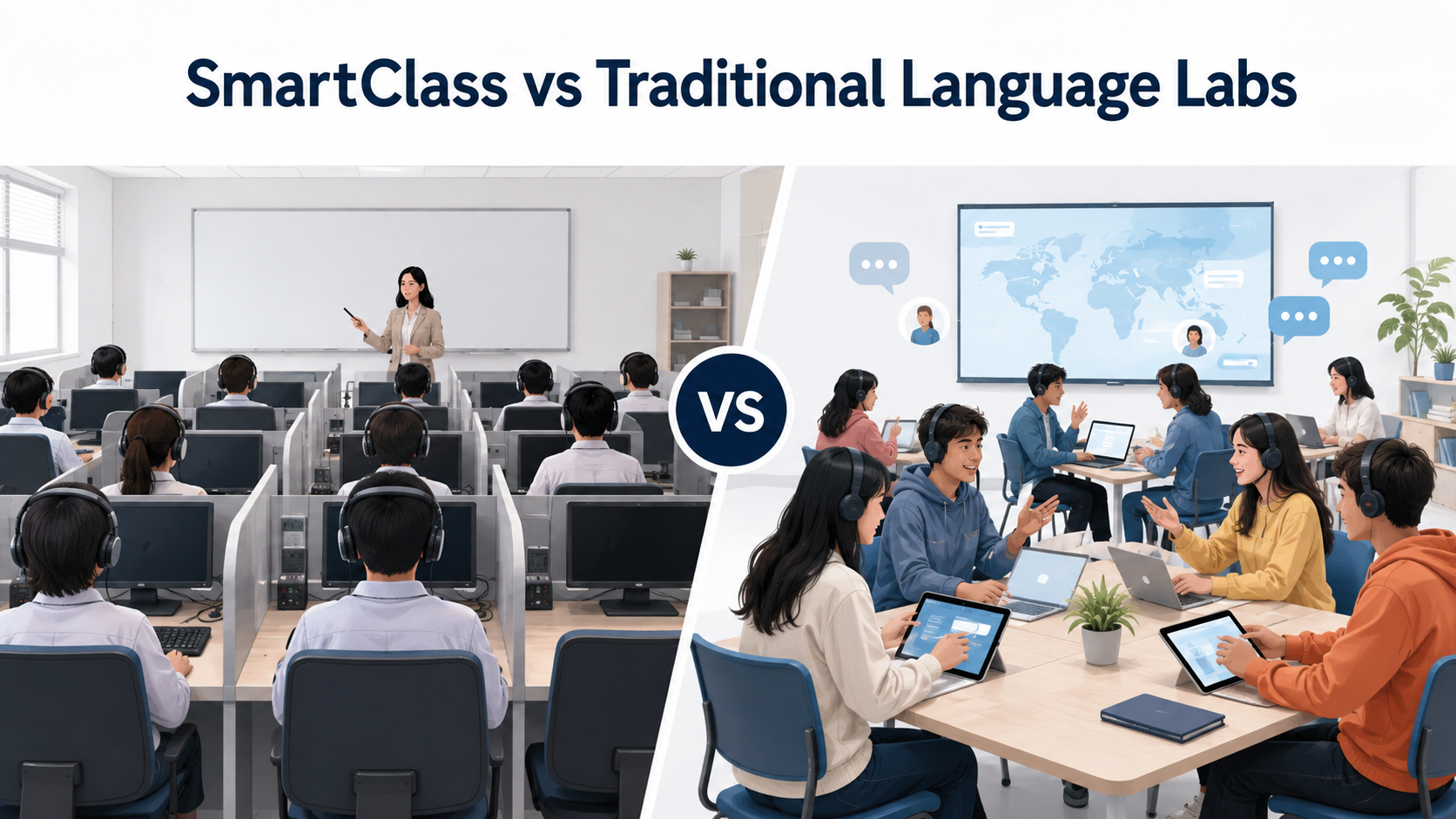
SmartClass by Robotel is a digital language learning platform that offers a more flexible and interactive alternative to traditional language labs. It supports speaking, listening, pronunciation practice, assessments, AI-powered conversations, group activities, and performance tracking, while allowing students to learn in classrooms, computer labs, at home, or in hybrid environments. This blog compares SmartClass with traditional language labs to help schools, colleges, and universities understand the differences in accessibility, teaching flexibility, student engagement, assessment, and language learning capabilities.
Over the last ten years, there has been a significant change in language instruction. Students are no longer restricted to using textbooks, language tapes, or fixed computer terminals when practicing speaking and listening. Nowadays, educational institutions expect language learning technology to be flexible, measurable, engaging, and compatible with the way students learn.
This change has led educators to ask themselves whether or not the institutions should keep on using traditional language labs or instead opt for a more flexible digital option such as SmartClass.
The answer varies according to the aims of the institution, its infrastructure, the teaching method it employs, and the needs of its students. Yet the difference between the two approaches is becoming more and more significant.
Traditional language labs were based on a physical room fitted with special audio equipment, headsets, teacher consoles, and individual student stations. Nowadays, platforms such as SmartClass achieve the main aim of a language lab by offering students more chances to listen, speak, practise, and get feedback. All of these are made possible through means of interactive software, digital materials, assessment tools, and flexible access.
What do you mean by traditional language labs?
Traditional language labs are instructional areas that are set up exclusively for the purpose of carrying out language practice; students work at separate stations which are fitted with headphones and microphones, while the teacher manages the audio equipment and the classroom activities from a central console.
For many years, the language labs had an important advantage when compared to traditional classroom teaching since students were able to listen to audio in the target language and practice their pronunciation without having to wait for the whole class to take part.
Traditional arrangements tend to rely heavily on physical facilities, since students usually have to be in the laboratory, use the assigned equipment, and carry out the activities which have been prepared in relation to the particular system's capabilities.
The model can still function adequately, especially in the case of a school that has a specific language-learning facility and a well-defined schedule for using it. However, modern teachers generally require greater flexibility.
What Is SmartClass?
SmartClass is a digital platform for learning languages, developed by Robotel to enable interactive language teaching in classrooms, computer labs, and online learning environments.
Instead of restricting language practice to a special room, SmartClass enables teachers to create, assign, keep track of, and evaluate activities using a digital platform. The students can take part in activities that involve speaking, pronunciation, listening, writing, vocabulary, and other language skills in a traditional language lab but also in a normal classroom setting, at home, or a hybrid setup.
Robotel’s SmartClass can be installed in an existing computer lab or used on laptops, tablets, and other devices in classrooms and will increase students' opportunities for speaking by means of activities such as AI conversations, working in pairs and groups, presentations, and pronunciation exercises.
The platform also has over twenty activity templates, integrated curricula, the ability to record and test, as well as reporting for tracking usage and performance.
That is to say, SmartClass isn't just a simple substitute for a headset and console setup; it stands for a more comprehensive method of digital language learning.
Key differences between SmartClass and traditional language labs
1. Flexibility: Starting with a room and developing into a learning platform
A major limitation of conventional language labs is the fact that they rely on a physical space.
When a school has thirty students taking a language course but only one laboratory, the laboratory timetable becomes a constraint. The classes have to be arranged in accordance with the availability of the room, the equipment, and the technical setup.
SmartClass provides an alternative approach; at Robotel, we ensure our platform can be accessed via the web, enabling teachers to create and assign activities as well as keep an eye on students' progress in various learning environments.
The language lab starts to be less concerned with the room itself and becomes more focused on the instructional experience.
2. Not just more listening, but more speaking practice
Acquiring a language demands that people practise actively; students should have the chance to use the language, not merely listen to a teacher or to pre-recordings. It is in this area that digital language platforms have the potential to greatly increase what takes place in class.
SmartClass features a range of activities focused on speaking, pronunciation, recordings, pair work, group work, presentations, and AI-powered conversations. This gives teachers the chance to get rid of the approach in which one student speaks, and all the other students listen.
More students can practice at the same time.
3. Assessment gets easier to act on
Another major difference between traditional language labs and modern digital platforms is the issue of assessment.
In a typical situation, a teacher could hear each student out, make notes, gather the assignments, and assess performance by hand. Although this does offer useful human feedback, it can prove difficult to handle when the number of students grows.
SmartClass provides recording and testing facilities, allows the use of customizable test templates, has integrated grading, maintains grade books, and includes performance reporting. As a result, teachers are given greater visibility into what their students are actually doing.
4. Learning can now be tailored
Students do not all start a language course with the same level of proficiency.
A student might require some extra work on his pronunciation, another might need assistance with vocabulary, and a third one might be ready to move on to more advanced conversational activities.
Although traditional language labs are capable of providing differentiated instruction, personalization is generally still reliant on the teacher, the materials available, and the arrangement of the lab.
Digital platforms allow different activities to be assigned to different learners. Teachers can choose activities and assign them in accordance with their instructional requirements; the SmartClass platform offers ready-to-use language courses as well as the possibility for educators to produce their own custom activities.
This means that the technology can be better suited to classrooms with students of different abilities.
5. Teachers obtain more than a control panel
In a conventional language lab, instructors have control over the audio in the classroom and that of the student stations.
A modern language platform can offer something even more valuable: visibility into the instructional process. Teachers are able to set up activities, hand out assignments, keep track of students' participation, grade their work, give feedback, and analyze their performance.
SmartClass also hosts a Smart Activity Builder. This can be used to create activities based on language, proficiency level, and topic. It decreases the amount of time teachers take on creating their own practice materials so that they can contribute more to teaching activities and giving feedback.
Practical Steps for Choosing the Right Language Lab Solution for Your Institution
Before buying a language learning system, school and university leaders should take a number of factors into account.
Evaluate Your Infrastructure
Have you already got computer labs or 1:1 devices? A solution based on software could enable you to make the most of your existing technology rather than having to set up a completely separate environment.
Consider Teacher Workflows
Teaching should be made easier by technology, not have another complex system imposed on teachers to deal with. Seek out tools that are intuitive for assigning work, keeping an eye on it, grading it, and creating content.
Look Beyond Hardware
While headsets and microphones can be helpful, they are only one part of the solution. The quality of the instructional material, the speaking exercises, the assessment features, the reporting tools, and the support offered to teachers can have a far greater effect on the learning experience.
Think About Learning Beyond the Lab
Students today have the option of receiving their education in the classroom, at home, in a blended format, or by working independently. A contemporary language platform should be capable of meeting the needs of these various situations.
Prioritize Speaking and Interaction
The aim of language teaching should be communication. You should assess whether the platform offers students real chances to speak, listen, interact, get feedback, and carry out practice repeatedly.
Wrapping Up: What choice should you make between SmartClass and traditional language labs?
Traditional language labs laid the foundation for technology-supported language teaching by providing teachers with tools that allowed students to become familiar with authentic audio, enabled individual practice, and offered more opportunities for listening.
But education has evolved, and so have the demands from modern language learning; the focus is largely on flexibility, meaningful interaction, personalization, measurable progress, and continuous practice.
While SmartClass is built on the fundamental concept of the language lab, the platform expands into a more flexible digital learning environment. It hosts some of the unique and most-desired features of a technology-enabled learning environment, like interactive activities, integrated curricula, pronunciation practice, AI-enabled activity creation, speaking, assessment, reporting, and more.
Lastly, the educational institutions looking to finalize their next language-learning investment must think about choosing the model that empowers their teachers with tools to educate learners effectively.
If your school, college, or university is evaluating language-learning technology, explore how SmartClass can work with your existing classroom or computer-lab environment.
FAQs
1. In what way SmartClass differs from a traditional language lab?
Traditional language labs are based on a physical room along with student workstations, headsets, and teacher consoles. On the contrary, SmartClass involves a digital environment for language learning to teach anywhere from computer labs to classrooms and even at home.
2. In what way does SmartClass improve students’ speaking skills?
It provides students the opportunity to participate in speaking, pronunciation, recording, pair works, group works, presentations, and conversation activities based on AI which makes possible practice for many students at the same time instead of being unable to speak due to waiting for one’s turn.
3. Is it possible to use SmartClass without a language laboratory?
Yes, SmartClass can be successfully used in computer laboratories and with laptops, tablets, and other devices in classrooms as well as at home and in hybrid conditions with no requirement for a language laboratory.
4. In what ways does SmartClass aid educators in evaluating their students' academic advancements?
SmartClass is equipped with assessment and recording functions, templates for tests that can be modified, auto-grading system, online daisy books, and informative reports on performance. All these options allow teachers to measure how students participate in class.
5. Which criteria must educational institutions bear in mind when selecting a language laboratory?
It is important to take into account the school’s technical framework, teaching strategies, materials used in the classroom, assessment and reporting technologies, and the extent of possibility for students to practice speaking.


.png?width=352&name=best-language-lab-systems-universities%20(2).png)

.svg)


Leave a comment