Universities today are expected to equip students not only with academic achievement but also with strong language and communication skills. With global careers, easy and better opportunities to study abroad, and diverse classrooms, the need to boost strong communication skills is now more essential than ever. Yet, conventional language instruction that doesn’t use modern language lab systems often fails to provide students with the time and resources needed to actually practice speaking and listening.
Wondering how a language lab system can make a significant difference? Well, they enable students to listen, speak, record, interact, get feedback, and practice at their own speed. At the same time, it empowers instructors with more control over classroom activities and assessment.
However, selecting the appropriate system can be challenging, especially where universities have to take into account scalability, the availability of teaching tools, student engagement, the ability to assess students, compatibility with different devices, the flexibility of the curriculum, and whether the platform is capable of supporting both classroom and distance learning.
Therefore, to help you narrow down your options, we have compiled a list of the best language lab systems and solutions that are worth considering for universities.
What Should Universities Look for in Language Lab Systems?
It is important to understand what makes a language lab effective in higher education before comparing the various platforms.
First, the system must offer support for the four basic language skills: Listening, speaking, reading, and writing, with more focus on speaking practice. Second, it must also enable teachers to keep track of students' activities, set exercises, record the students' responses, give them feedback, and assess their progress.
Universities should also consider:
- Compatibility with existing computer labs and devices
- Cloud-based or on-campus deployment options
- Support for multiple languages
- Teacher-led and self-paced learning
- Recording and pronunciation practice
- Assessment and reporting
- Integration with existing teaching workflows
- Scalability across departments and campuses
- Ongoing technical and pedagogical support
5 Noteworthy Language Lab System Options
-
SmartClass by Robotel
For universities in search of a comprehensive language lab solution, SmartClass by Robotel can be your go-to option.
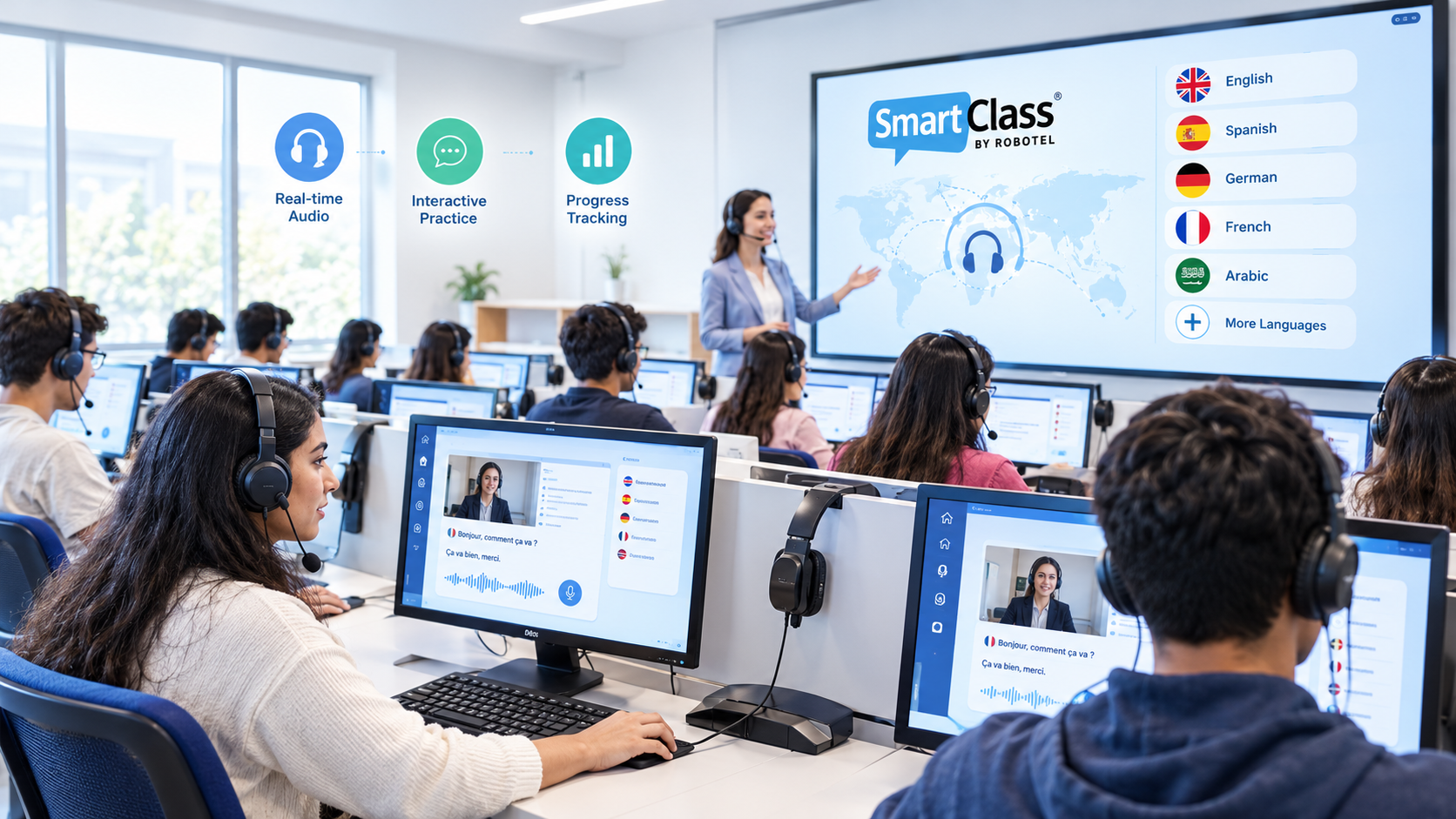
SmartClass integrates an interactive language lab with a flexible teaching platform for both classroom and online learning. It hosts tools that enable teachers to create and assign activities, keep an eye on students, give feedback, and assist with individualized learning.
A major benefit of it is the focus on increasing the amount of time that students actually spend speaking. SmartClass includes activities for partner work, group work, presentations, pronunciation, conversation, recording, and assessment. It is also possible for teachers to keep an eye on students' activities.
The platform offers over 20 activity templates and thousands of activities in a number of languages. Currently, the preloaded curricula are available in English, German, Spanish, and Arabic, and teachers can create activities for other languages if necessary.
Scalability is a top priority for universities; thus, SmartClass is designed to serve language departments, multiple classrooms, and broader deployment within an institution. Moreover, we have installations in over 90 countries and are still expanding our cloud-based and AI-supported features.
What Makes SmartClass Different?
- Artificial Intelligence that actively supports language practice, like pronunciation tools and AI conversations.
- More personalised learning through adaptable activities, redo options, and immediate feedback.
- Reporting tools for better visibility into outcomes for administrators, students, and teachers.
- From creating and adapting activities for different proficiency levels, academic subjects, languages, and vocational requirements, the platform is customizable for any language or learning need.
- Flexibility across teaching environments: SmartClass supports classroom, online, and hybrid learning, adapting to the way modern universities teach.
Ideal for: Universities looking for a comprehensive, scalable solution for language teaching and labs.
2. Sanako Connect
Sanako Connect is a language teaching platform that is based on the web and has been designed specifically for use in schools and universities.
Emphasis is placed on speaking, listening, and pronunciation, and teachers are able to carry out whole-class speaking activities, pair and group discussions, role plays, recordings, and automated pronunciation grading.
Since Connect is based on the web, it is capable of supporting both face-to-face and remote teaching; this feature makes it especially suitable for universities that have hybrid programmes or that provide instruction to students beyond the physical language lab.
Ideal for: Universities that prioritise web-based, collaborative speaking and listening activities.
3. CAN-8 VirtuaLab
Used in colleges and universities since 1993, this cloud-based virtual language classroom focuses largely on oral language production.
Instructors can create tailored lessons, divide the students into groups, keep an eye on their work, give them feedback, and assess both written and spoken responses. Additionally, the students can take part in recorded conversations and finish their assignments remotely.
According to CAN-8, the network-based licensing enables institutions to use the platform across various departments and locations without limiting it to individual workstations. The system also supports both in-lab and remote access.
Best for: Universities that require flexible oral-language practice and access across several campuses.
4. Oréll Talk
Oréll Talk is also an established choice that offers English in addition to over 25 other languages. Apart from listening, speaking, reading, and writing, it provides conversations, group discussions, debates, and language activities, among other career-oriented language activities.
Oréll also offers a framework that is aligned with the CEFR-aligned courseware and features AI-powered language learning. The platform provides hybrid learning and mobile access, which makes it appropriate for organisations seeking an option that goes beyond a conventional computer-room arrangement.
Ideal for: Universities looking to establish a comprehensive language-learning environment that includes AI, CEFR materials, and activities focused on career-oriented communication.
5. DiLL (Digital Language Lab)
DiLL was originally developed at Northwestern University and is now exclusively licensed and supported by Swift Education Systems.
The platform emphasises instructor-led language-lab interaction. Teachers can pair or group students, initiate conversations, distribute audio exercises, monitor student work, and automatically save the recordings for subsequent evaluation.
DiLL is especially suitable for universities with Mac-based language classrooms; the University of Minnesota is currently using DiLL across its language center classrooms. Boston College also hosts a digital language lab operating on DiLL.
Ideal for: Universities that have Mac-based language classrooms and have strong requirements regarding instructor-led lab sessions.
How to Choose the Right Language Lab System for Your University
There isn't a one-stop platform or solution that matches the requirements of every institution. The right choice of language lab system will vary according to the university's teaching model, its student body, the technology infrastructure it has, and its language programmes.
With larger universities, scalability and centralised reporting might be the main concerns, but for a department dealing with language teaching, instructor-led conversation and the assessment tools used may be more important. Universities that have hybrid programmes might choose cloud-based systems, while those on campuses with poor connectivity may find it advantageous to have offline functionality.
Universities should also not assess language lab software simply by the number of exercises it has; the crucial factor is how well the system provides students with opportunities to use the language.
A good system should enable students to speak more, listen more, get timely feedback, and carry out repeated practice without being restricted by the usual classroom setting.
Final Thoughts
Language education nowadays is shifting from a passive approach to an active practice. Universities require tools that enable students to communicate, carry out experiments, make mistakes, get feedback, and keep on improving.
The top five language lab systems mentioned above take different approaches to this problem. Sanako has classroom and web-based solutions of its own, CAN-8 places a strong emphasis on customizable oral practice, Oréll Talk integrates language learning with wider institutional facilities, and DiLL provides a robust Mac-based lab environment that is capable of supporting self-paced learning on a large scale.
SmartClass by Robotel stands out as a particularly strong choice for universities seeking a complete language lab solution that includes interactive classroom activities, speaking practice, assessment, teacher monitoring, curriculum, and flexible online access.
A word of caution! The only way to assess any system is to observe it in operation; therefore, universities should ask for a demonstration, get the members of their language departments involved in the evaluation, and check how easily the platform can be incorporated into their present curriculum and infrastructure before finalizing any long-term decision.
Willing to build a more interactive university language lab?
Visit our website to see how SmartClass by Robotel can transform language teaching throughout your university.
Ask for a SmartClass demo today.
FAQS
1. What does a language lab system mean?
A language lab system is the digital platform formulated for students to practice all components of language, including listening, writing, reading, and speaking via methods of interaction. Instructors are also provided with tools for assigning practical tasks, observing the student's actions, giving feedback, and measuring progress.
2. What must universities consider when selecting a language lab system?
Universities need to be concerned about several criteria while optimizing their language lab systems. These criteria comprise language practice facilities, compatibility with devices, deployment alternatives, language variety, teacher supervision, pronunciation and recording capabilities, as well as scalability and integration aspects.
3. How can language lab systems assist in improving the speaking skill of students?
Language lab systems provide students with better speaking practice, which involves a list of activities such as conversations, group and pair speaking, presentations, pronunciation exercises, and other exercises. In addition, students receive feedback about their speaking and are able to repeat the mentioned activities to make their speaking more effective.
4. Is it possible for language lab systems to operate in both conventional modes and distance learning?
Absolutely. Most contemporary language lab systems function in both conventional – classroom-based – learning and distance learning modes. Cloud-based solutions facilitate remote access to tasks for students as well as provide teachers with capabilities for effective assignment distribution, activity monitoring, and feedback collection.
5. How can universities determine which language lab system can work for them?
When considering a variety of systems, educational institutions should be driven by their needs for teaching methods, student demographics, technological readiness, language programs, and scalability. Potentially useful techniques include demonstration demands, evaluation inclusion of language department members, etc.




.svg)
.jpeg?width=352&name=AdobeStock_28748264%20(1).jpeg)


Leave a comment